Understanding the Scope of Practice
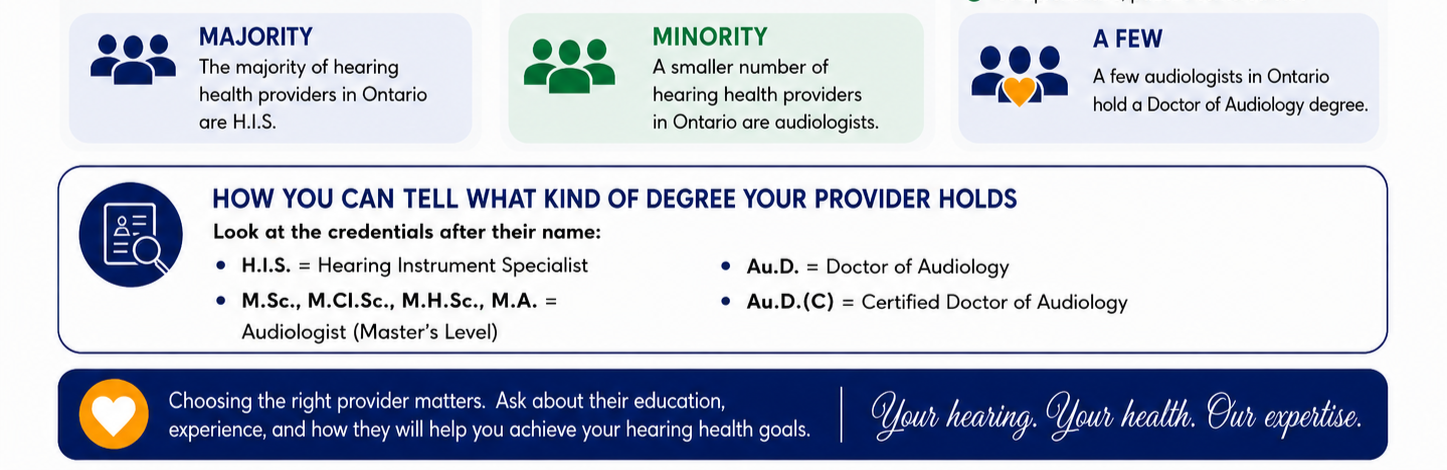
Doctor of Audiology — Au.D.
An audiologist with additional doctoral-level education and advanced clinical training. Although the regulated scope of practice in Ontario is the same as that of a master’s-trained audiologist, the Au.D. reflects a higher level of professional education, advanced clinical knowledge, and enhanced expertise in areas such as otology and medically related ear concerns, tinnitus, hearing rehabilitation, cognitive considerations, and the selection, prescription, fitting, and verification of hearing devices to support optimal hearing and cognitive rehabilitation.
Audiologist — M.H.Sc., M.Sc., M.A., or Equivalent Master’s Degree
Provides comprehensive hearing assessments, hearing rehabilitation, tinnitus care, auditory processing services, and hearing device selection, prescription, fitting, programming, maintenance, and support.
Hearing Instrument Specialist — H.I.S.
Focuses mainly on basic hearing testing for hearing aid purposes, fitting, programming, maintenance, and support.
Ear, Nose and Throat Physician — ENT / Otolaryngologist
A medical doctor and surgical specialist who diagnoses and treats diseases and disorders of the ears, nose, throat, head, and neck. ENTs manage medical and surgical conditions such as chronic ear infections, eardrum problems, sudden or unexplained hearing loss, structural abnormalities, persistent dizziness, and other conditions requiring medical investigation, medication, imaging, or surgery.
ENT physicians do not typically provide ongoing treatment or hearing-device care for age-related hearing loss. When hearing rehabilitation is needed, they generally refer patients to an audiologist for comprehensive assessment, hearing-device recommendations, fitting, verification, and follow-up care.