Prescription Hearing Devices & Audiological Rehabilitation
Doctor of Audiology-Led Care for Hearing Loss
At Ottawa Hears Audiology, every recommendation begins with a comprehensive evaluation of your hearing, communication difficulties, medical and hearing history, listening environments, personal goals, and individual needs.
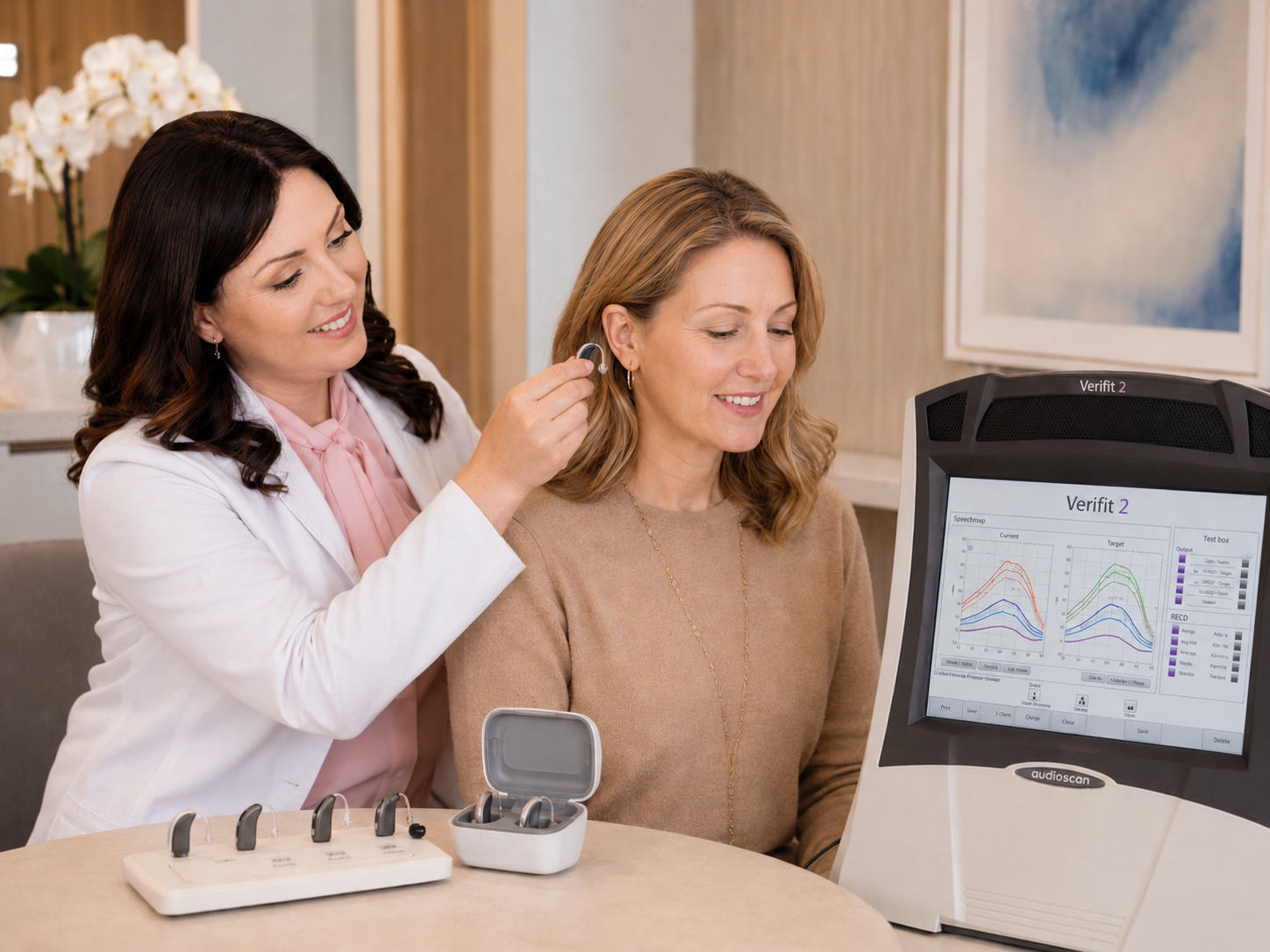
When hearing devices are appropriate, they are professionally prescribed and personalized by our Experienced and Knowledgeable Genia Kanne-Shmigol, Doctor of Audiology, audiologist. Your care includes clinical assessment, device selection, advanced fitting, verification, counselling, rehabilitation, and ongoing follow-up.
We use advanced audiological equipment and evidence-based fitting methods, including real-ear measurement and verification, to help ensure the most accurate, personalized, and effective hearing-device fitting possible for optimal hearing rehabilitation.
Hearing Care Begins with an Accurate Evaluation
Not every hearing problem has the same cause, and not every person with hearing loss requires the same solution.
Before recommending hearing devices, we evaluate the type and degree of hearing loss, speech understanding, ear and middle-ear function when indicated, communication needs, and other factors that may influence treatment.

We commonly help adults experiencing:
✓ Age-related hearing loss, also called presbycusis
✓ Sensorineural hearing loss
✓ Difficulty understanding speech in background noise
✓ Trouble hearing soft or high-pitched voices
✓ Frequent requests for repetition
✓ Television or telephone volume that is louder than others prefer
✓ Listening fatigue or difficulty keeping up with conversations
✓ Tinnitus occurring with hearing loss
✓ Hearing changes associated with noise exposure, genetics, illness, or certain medications
✓ Limited benefit or discomfort from hearing devices fitted elsewhere
The purpose of the assessment is to determine the most appropriate treatment—not to assume that every patient requires hearing devices.
A Complete Clinical Hearing-Care Process
Hearing devices are only one part of hearing rehabilitation. Our approach follows a complete clinical process:
Comprehensive Audiological Evaluation
We evaluate your hearing and speech-understanding abilities, review your case history, and identify findings that may require additional investigation.
Determination of Hearing-Device Candidacy
We consider whether hearing devices are clinically appropriate and whether other treatment, monitoring, communication strategies, assistive technology, or medical referral may be more suitable.
Personalized Hearing-Device Prescription
When hearing devices are recommended, your prescription is based on your audiological results, communication needs, ear anatomy, comfort, dexterity, vision, lifestyle, technology requirements, preferences, and budget.
Professional Fitting and Programming
Your devices are programmed according to your individual hearing prescription rather than relying only on the manufacturer’s initial settings.
Real-Ear Verification
Real-ear measurements are used to evaluate the sound delivered inside your ear and verify that the hearing devices are performing appropriately for your hearing loss.
Validation and Optimization
We assess your comfort, sound quality, speech understanding, and real-world benefit. Adjustments are made according to your experience and clinical results.
Rehabilitation and Continuing Care
Ongoing care may include counselling, communication strategies, fine-tuning, maintenance, assistive-listening technology, family education, and follow-up evaluations.
Independent and Manufacturer-Neutral Recommendations
Ottawa Hears Audiology is an independent clinic. We are not limited to one hearing-device manufacturer or corporate product line.
We have access to both economical and advanced hearing technologies, including AI-powered options, from major global manufacturers. This allows recommendations to be based on your clinical needs, lifestyle, preferences, and budget — rather than brand loyalty.
Options may include:
✓ Rechargeable or replaceable-battery devices
✓ Bluetooth and smartphone connectivity
✓ Behind-the-ear and receiver-in-the-ear styles
✓ Custom in-the-ear and nearly invisible options
✓ Power devices for more significant hearing loss
✓ Remote microphones and television-streaming systems
✓ Assistive-listening and FM technology
✓ Bone-conduction solutions when clinically appropriate
When implantable technology may be appropriate, we can recommend referral for a cochlear-implant or implantable-hearing-device candidacy evaluation.
Medical Referral and Collaborative Care
Some hearing changes require medical investigation rather than—or before—a routine hearing-device fitting.
When test results or symptoms suggest the need for additional assessment, we explain our findings and recommend appropriate follow-up with a:
✓ Family physician or nurse practitioner
✓ Otolaryngologist—Ear, Nose and Throat specialist
✓ Neurologist
✓ Cochlear-implant or implantable-hearing-device program
✓ Other appropriate healthcare professional
With your consent, audiological reports and relevant findings may be shared with your healthcare providers to support coordinated care.

Understand the Difference: Hearing Health Providers in Ontario
Not all hearing care providers have the same education, training, or clinical focus. This page explains the difference between Hearing Instrument Specialists, Audiologists with a Master’s degree, and Audiologists with a Professional Doctorate degree so patients can make an informed choice about their hearing care.
Insurance Coverage
Please verify your benefits directly with your insurance provider. Audiology clinics do not direct bill private insurance; receipts are provided for reimbursement. Coverage may be listed under audiology, audiologist, hearing test, hearing aid, hearing device or other.
Authorized 3rd Party Provider For :
✅ Assistive Devices Program (ADP)
✅ Non-Insured Health Benefits (NIHB)
✅ Ontario Disability Support Program (ODSP)
✅ Veterans Affairs Canada (VAC)
✅ Workplace Safety and Insurance Board (WSIB)